Approximate location — plotted from published sources, not a site visit, and not a guarantee of access.
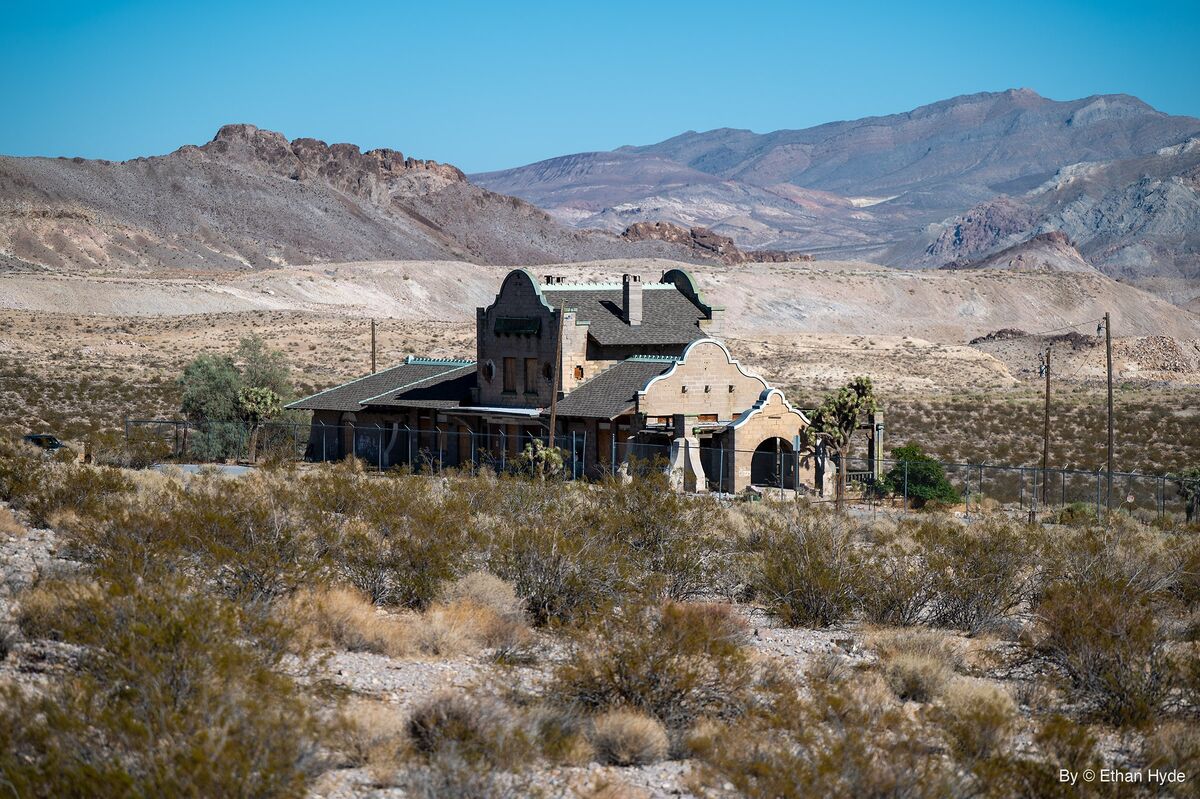
One of the West's most photogenic ghost towns — ballooned to 10,000 residents during the 1905 Death Valley gold rush then collapsed just as fast. The three-story Cook Bank, Bottle House (50,000 beer bottles), and train depot are iconic ruins.
Artifacts & structures are protected by federal law (ARPA) — take only photos, leave every relic in place.
Peak Pop.
10,000 (1907)
Era
1905-1911
Access
Paved road
Fee
Free
A gold strike in the Bullfrog district
The National Park Service says prospectors Shorty Harris and E. L. Cross found quartz across a hill in 1904. Harris called it “the original bullfrog rock.” At the time, the only other person in the area was a rancher, Old Man Beatty, about five miles away. Camps including Bullfrog, Amargosa, and Jumpertown followed, and the townsite took its name from the silica-rich volcanic rock nearby, rhyolite. Travel Nevada dates the founding of the town to 1905, within what became the Bullfrog Mining District.
The Park Service says Charles Schwab bought the Montgomery Shoshone mine in 1906, for a reported $2 to $6 million. Electricity reached town in April 1907. Travel Nevada says the town grew from a two-tent camp to about 5,000 people within six months, and lists three banks, a stock exchange, an opera house, a hospital, and 50 saloons. The Park Service gives no peak population. The Las Vegas Review-Journal says only “several thousand.”
Decline
The Park Service treats the financial panic of 1907 as the start of the decline. Its figures show how fast it went: 611 residents in 1910, and a vote on March 14, 1911 to close the Montgomery Shoshone mine and mill. Power was shut off in 1916. Travel Nevada reports 14 residents in 1920. The Review-Journal says the last train left the depot in 1914. Travel Nevada says buildings were dismantled and their materials reused in new buildings in Beatty.
What remains
Some walls of the three-story bank building still stand, along with part of the old jail. The Bottle House was built by Tom T. Kelly from about 50,000 bottles. The Park Service dates it to 1906 and the Review-Journal to 1905. The Park Service says Paramount Pictures restored it in January 1925, and the Review-Journal says more repairs used donated bottles in 2005. The train depot, a 1907 building, still stands. The Park Service says it is privately owned. The Review-Journal says only a couple of intact buildings remain. The rest are ruins, foundations, and faint street lines.
The Goldwell Open Air Museum, began in 1984 and sits just below the ruins, according to Travel Nevada. The Review-Journal says its sculptures are open daily to visitors free of charge.
Visiting today
The Park Service says Rhyolite is not inside Death Valley National Park and that the land is a mix of federal and private ownership. Travel Nevada names the Bureau of Land Management as manager of the ghost town and says it is open every day from sunrise to sunset at no charge. The sources give different distances to Beatty: four miles in the Review-Journal and six in Travel Nevada. Both place Rhyolite on a short side road off State Route 374. The Park Service says to take the paved road north from the highway. Respect private property, and leave every artifact in place. Check with the Bureau of Land Management for current conditions.