A gold camp called the Widowmaker
Delamar is a gold-mining ghost town in Lincoln County, reached by a road that leaves US 93 near Caliente. The camp began as Ferguson, named for the prospector who made the first strike. Sources disagree on the date. Nevada State Historical Marker No. 90 says John and Olivia Ferguson found gold around 1891. Legends of America says John Ferguson and Joseph Sharp found it in 1889 in Monkeywrench Wash. The Las Vegas Review-Journal says only that Mormon farmers from Pahranagat Valley found gold-bearing rock in the early 1890s.
The camp took its later name from a Montana investor, Captain John De Lamar. The state marker says he bought the best mining claims in 1893 for $150,000. The Review-Journal also dates his purchase to 1893 and says development of the new camp began in 1894. Legends of America dates his purchase to April 1894 and calls him Joseph Rafael De Lamar in one place and John R. Delamar in another, so the article is not consistent with itself. A fifty-ton mill started in May 1895, according to Legends of America, and the post office and a newspaper, the Delamar Lode, date to 1894.
Reports of the town’s size and output vary. The marker says more than 1,500 people lived there, with a newspaper, hospital, school, churches, saloons, stores, a theater and an opera house. Legends of America also gives more than 1,500. The Review-Journal says about 3,000. On gold, the marker says $25,000,000 and calls Delamar Nevada’s leading producer at the turn of the twentieth century. Legends of America reports more than $15 million from 1892 to 1909. The Review-Journal gives a total of $13.5 million and says Delamar led the state from 1895 to 1900 before falling just behind Tonopah and Goldfield.
Dust and water
Water was scarce. The marker says it came from Meadows Valley Wash, 12 miles away, and that supplies came by mule team from the railroad at Millard, Utah, more than 150 miles off. Legends of America spells the railroad town Milford. The Review-Journal describes a pipeline with several pumping stations carrying water over the mountains from Meadow Valley.
The nickname comes from silica dust. The marker says the fine dust from early dry milling killed many residents. Legends of America says the gold lay in quartzite that produced a glass-like dust, that it caused silicosis, and that at one time more than 400 widows lived in town.
The Review-Journal says the boom was over by 1909. Legends of America says many residents had left for Tonopah by 1902 and the mines were dismantled in 1909. It adds that the post office and school reopened in 1929 and that production ended in 1934. The marker gives the camp’s dates as 1893 to 1909.
What remains and visiting today
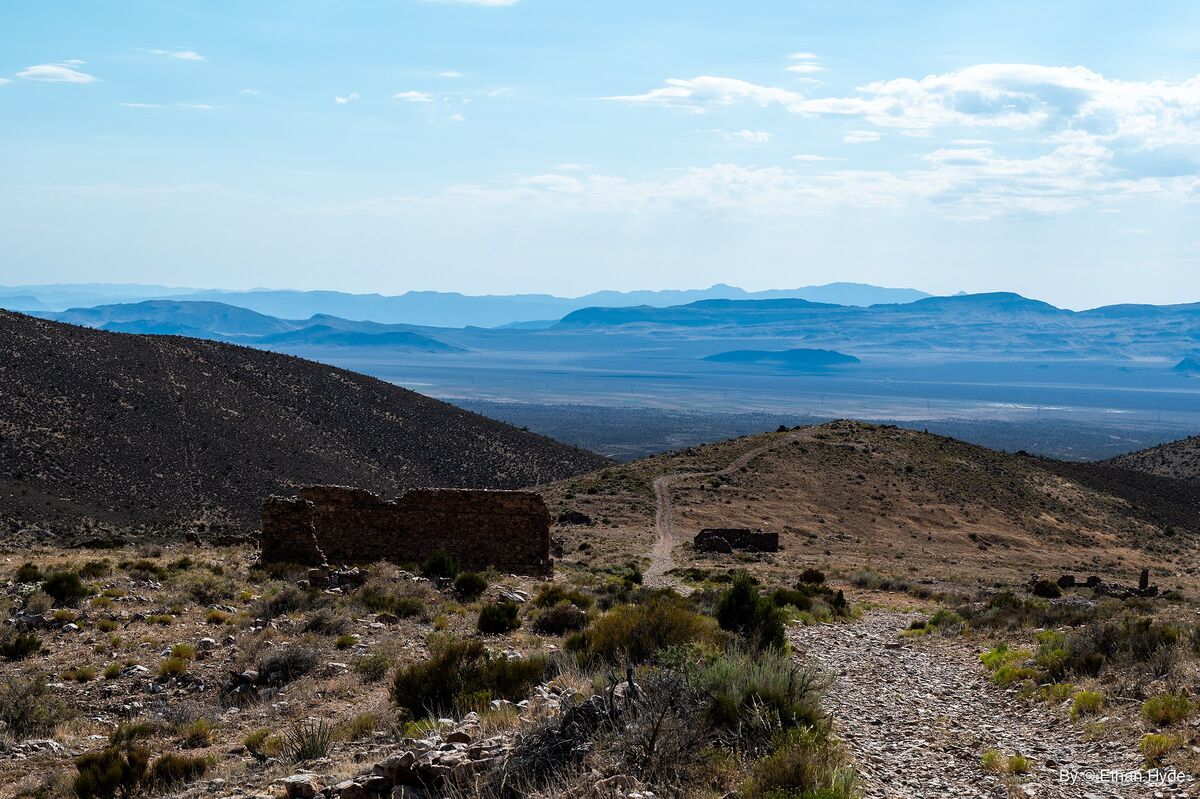
The Review-Journal describes a small, roofless stone building beside the road, a fenced cemetery with a few headstones and ornate metal grave fences, stone ruins, mill floor girders, mine dumps, open glory holes and tunnel entrances. Legends of America says vandals dismantled several standing stone buildings looking for hidden items in the walls, and it reports two cemeteries.
Both articles describe the same approach. Leave US 93 on the marked Delmar Road, which the Review-Journal calls a graded road, then take a rougher side road about 16 miles into the foothills. Legends of America calls the route rugged gravel and recommends four-wheel drive. The Review-Journal article was published in 2010 and the marker is listed by the state as missing, so check road conditions with the Bureau of Land Management before going.
The Review-Journal warns visitors to stay out of the tunnels because the old wooden shoring is dangerous, and to watch for open shafts. Leave the cemetery, the stonework and any artifacts where they are.
Plan ahead. Leave no trace. Verify current access before traveling.